




Knitting and art: how to create unique pieces?
Knit SisShare
Knitting and art: how to create unique pieces?
What if your knits became not just clothes or accessories, but true works of art? The fusion of knitting and art opens up a fascinating universe — bold patterns, sculptural textures, yarn bombing installations… In this article, I'll take you on this textile and artistic journey: what approaches to adopt , what techniques to explore , how to find inspiration , and above all, how to design a unique and signature knitted piece .
In the end, you will leave with ideas to test, references to textile art, and concrete tips to make your Knit-sis projects truly creative pieces.
1. Why knitting can become art
1.1 Knitting as an artistic medium
Knitting is no longer just a hobby or a craft: in the hands of contemporary artists, it becomes a visual language, a form of volume, an expression. It engages in a dialogue with spaces, shapes, and light. Some installations feature giant knits covering buildings, or structures made of wool yarn that play with emptiness.
For example, the urban knitting (or yarn bombing ) movement , which covers elements of the city with colorful knitwear, perfectly illustrates this encounter between street art and textile fibers.
1.2 Symbolism and narrative
Knitting can convey a message, an emotion, a symbol. Traditional motifs like the Selburose in Norway, an iconic stylized star, are rooted in cultural heritage. Similarly, in contemporary movements, color, the interplay of positive and negative space, and effects of transparency or relief tell visual stories (identity, memory, space).
1.3 Artist Inspirations
Among the artists reinventing knitwear, we can mention Gaspard Fleury-Dugy , a young visual artist who transforms organic forms into knitted “soft objects,” blending programming and textile volume.
At Knit-sis, we have already explored this porous boundary between art and knitting in our articles on contemporary knitted artists.
2. Approaches & techniques for artistic knitted pieces
2.1 Pictorial motifs / intarsia & jacquard
▪️ Use intarsia to create strong shapes, independent color areas.
▪️ Adapting jacquard/Fair Isle for colorful repeating patterns — a historical but still expressive technique
▪️ Play with color contrasts to achieve a “knitted design” effect.
2.2 Textures, reliefs & volume
▪️ Voluminous twists, honeycomb patterns, pronounced ribs: these are “tactile imprints”
▪️ Raised dots (cables, popcorn dots) to play with the light
▪️ Layering: knitting strips or panels that are then assembled to create a raised effect
2.3 Sculptural & Geometric Structures
▪️ Knit modular pieces (hexagons, triangles) that are assembled like a patchwork
▪️ Play with tension, density, or areas of loose vs. tight weave
▪️ Create three-dimensional elements (protrusions, inflated shapes)
2.4 Installation & textile art
▪️ Create non-portable works (tapestries, wall decorations, wire sculptures)
▪️ Integrating knitting into installations, suspended, in three dimensions
▪️ Considering the use of knitwear beyond clothing: knitted domes, wool nets, suspended textures
3. How to design a knitted art piece: a step-by-step method
3.1 Inspiration Phase
▪️ Create a mood board: explore Pinterest, textile galleries
▪️ Gather patterns, color palettes, shapes
▪️ Note what “speaks to you” (geometric shapes, plants, organic materials…)
3.2 Sketches & prototypes
▪️ Sketch your ideas on graph paper: imagine your design as a grid
▪️ Create mini-samples : small squares of texture, pattern, volume
▪️ Adjust your proportions, your contrast
3.3 Mesh translation
▪️ Calculate the number of stitches/rows according to your gauge swatch
▪️ Convert shapes and proportions into a grid or construction plan
▪️ Identify the key points: transitions, borders, junctions
3.4 Knitting / Assembly / Finishing
▪️ Knit your modules (plates, strips)
▪️ Assemble, layer, secure (sewing, pins, fabric adhesive)
▪️ Block and adjust the rendering
▪️ Add decorative elements (pom-poms, loose threads, beads) if desired
4. Knit-sis Project Ideas & Inspiration to Get Started
Here are some suggestions from our art-inspired designs:
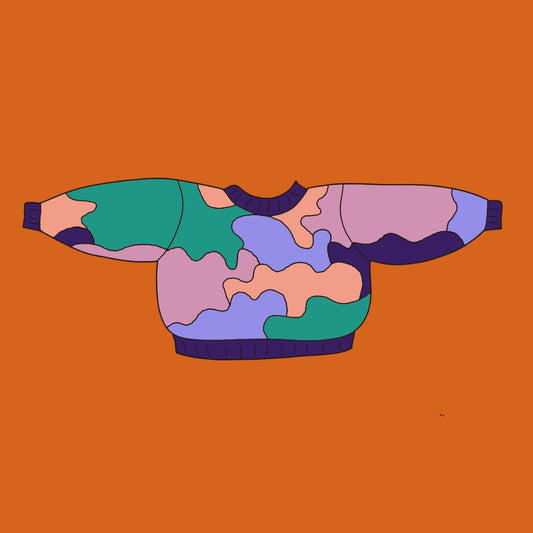
▪️ Splashie Its color blocks facilitate the integration of intarsia patterns or graphic variations.
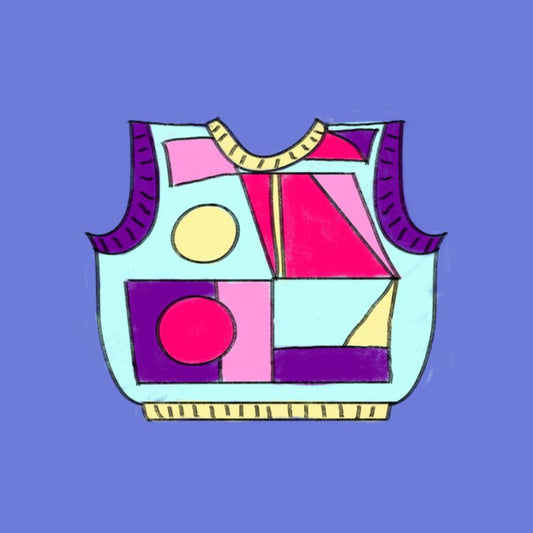
▪️ Mondrian : a natural geometric pattern to be transformed or adapted into an artistic version
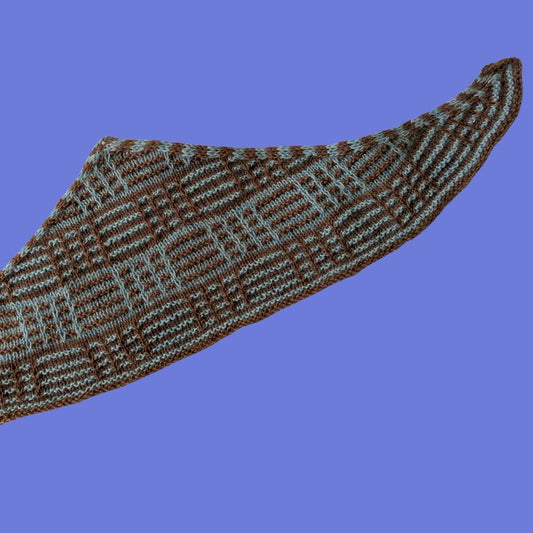
▪️ Vasarely : soft structure, ideal for sewing or placing decorative elements
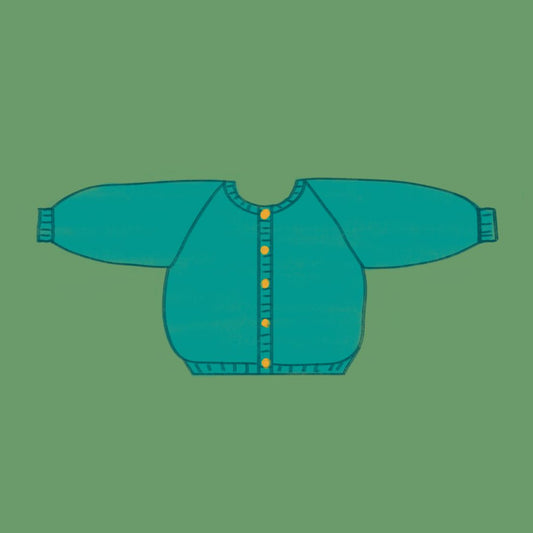
▪️ Chroma : Available for free on the Katia website
5. Key points to remember
To create a knit art piece, start with an inspiring mood board, draw a pattern on a grid, make mini-swatches, then translate it into stitches. Mix colorful patterns (intarsia/jacquard), embossed textures, or modular structures to create a unique piece to wear or display.
6. Tips for creating a successful artwork
▪️ Choose a well-defined yarn with few "fibers" to ensure the pattern remains crisp.
▪️ Plan for highly contrasting names (light/dark)
▪️ Test small first : mini-projects or samples
▪️ Don't be afraid of "artistic failure"; each attempt brings you closer to a unique style.
▪️ Maintain a certain consistency (colors, texture) to ensure your room is harmonious
7. Conclusion
Knitting can become art, expression, a signature creation. By combining techniques, textures, patterns and imagination, you can bring to life unique pieces — wearable or displayable — that tell a story.
👉 Sign up for our newsletter to receive “Knitting-Art” inspiration sheets , exclusive patterns and guides to bring your piece to life.
👉 Browse our Knit-sis collection to find a pattern to customize or fragment for your art project.
Beautiful creations, beautiful explorations, and may your stitches become your works of art ✨
With all our creative heart,
Lenny & Louise, your Knit-sis sisters


