






How to make a chain stitch in knitting? Step-by-step tutorial
Knit SisShare
When we were little, our grandmother showed us "magic" stitches that changed the look of a knitted piece—one of her favorites was the chain stitch , also called the knitted chain or openwork chain . This stitch is elegant, decorative, and adds a touch of originality without any fuss.
In this article, you will discover:
▪️ What exactly is the chain stitch in knitting?
▪️ Why and when to use it
▪️ A step-by-step tutorial (with photos or illustrations)
▪️ Common mistakes to avoid
▪️ Knit-sis pattern ideas where to incorporate it
▪️ A demonstration video
By the end of this guide, you'll be able to knit this stitch with confidence, even if you're a beginner 🧶. And if you want to take it further, you can choose a compatible pattern from our shop.
What is the chain stitch in knitting?
Short answer : The chain stitch in knitting is a decorative motif that creates a line of "chain" (loops) in the work, often raised or openwork. It can be incorporated into a larger pattern or used as a decorative border.
Variants and synonyms
▪️ Knitted chain
▪️ Openwork chain stitch
▪️ Decorative chain stitch
▪️ Chain stitch (in English)
Depending on the context, the stitch can be openwork , raised , or transformed into a decorative motif.
( For example, the Instants de Louise website offers a tutorial for the chain stitch “like a light cable” by knitting two stitches together in a specific way )
Why use the chain stitch? Advantages and uses
Aesthetic appeal & decorative finesse
The chain stitch provides a fine line, a wave or a delicate pattern, perfect for personalizing a vest back, a border, a central motif.
Texture variation without extreme complexity
Compared to complex twists or lace, chain stitch can be more accessible while still offering an interesting visual variation.
Integrable with Knit-sis models
Here are some ideas where you could incorporate this point into one of our patterns:
▪️ Marguerite (romantic openwork): the chain stitch can be inserted into open spaces
▪️ Aude (fine lace): to add a decorative border
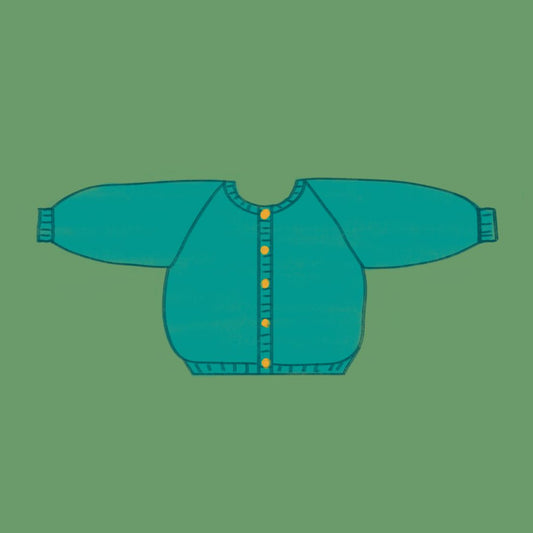
▪️ Cardichou : in a pattern on the sleeves or back for a delicate touch
👉 If you want to experiment, start with a small piece (scarf, strip, sample) before adding it to a large project.
Step-by-step tutorial: how to knit the chain stitch
Here is a step-by-step guide to knitting the chain stitch. Feel free to follow along while working with a swatch.
Preparation & equipment
▪️ Use a thread that holds its shape well (not too slippery)
▪️ Use needles one size smaller than your recommended thread size, so that the loops don't "flatten"
▪️ Cast on an appropriate number of stitches (often a specific multiple depending on the pattern)
Detailed steps
1️⃣ Cast on the stitches
Cast on your knitting as usual (garter stitch, stockinette stitch according to the pattern).
2️⃣ Base rank (optional)
Knit one row of knit stitches or the basic pattern before entering the stitch.
3️⃣ Create the chain (simple example)
▪️ Knit 2 stitches together (K2tog without slipping) : knit two stitches together but without slipping them off the needle (two stitches remain on the right needle).
▪️ With the left needle, insert the needle behind the 2nd stitch towards the front of the first stitch (like a cable)
▪️ Release the two stitches (they will fall)
▪️ Pick up the loose stitch with the right needle, bring it back over the left needle to reform the chain line
▪️ Repeat across the entire row
4️⃣ This process is described in the “Instants de Louise” tutorial to create a chain at the same time as knitting, without external addition.
5️⃣ Back row / Next row
Depending on the pattern, you knit in stockinette or purl, or you maintain the chain stitches every two rows. Some lace versions require an additional yarn over or decrease.
6️⃣ Finish the chain
When you want to “close” the line, you can merge the chain stitch by knitting it with the neighboring stitch (together, decrease) or conceal the stitch in a border.
Common mistakes & tips to avoid them
Do not secure the loose mesh
If you don't pick up the stitch correctly, it can unravel or become distorted. Always check that the loop stays in place before moving on to the next row.
Tension too loose
If the loops are too loose, they won't be noticeable. If they're too tight, they'll flatten. Practice on a swatch and adjust your technique or needle size.
Do not repeat the pattern regularly
If you forget to chain all the required rows or if you shift the starting point, the row will become misaligned. Mark the beginnings of the pattern, count the stitches.
The chain ends incorrectly
If you don't finish the chain neatly (merging, decreasing), you can create a visible "hole" or a dangling stitch.
Variations & creative ideas for chain stitch
▪️ Openwork chain : incorporate a yarn over + decrease to create small decorative holes
▪️ Double chain : two parallel lines for a decorative “cord” effect
▪️ Raised chain stitch : highlight a line with a lighter or raised thread
▪️ Combined chain with twists : for a mixed pattern
The article Learn to knit the openwork chain stitch offers a version using yarn overs & decreases to obtain an openwork V pattern.
Knit-sis patterns for experimenting with the chain stitch
Here are three patterns in which you can incorporate or test the chain stitch:
▪️ Marguerite : thanks to its openwork pattern, you can replace or mix some of the "small openings" with a chain
▪️ Aude : for a thin border or a decorative insert
▪️ Cardichou : a discreet chain motif on the sleeves or neckline can enhance this simple vest
☑️ If you're curious, I can send you modified versions of these patterns with the chain stitch integrated, so you can test them immediately.
Conclusion
The chain stitch is a little gem in a knitter's arsenal: discreet, elegant, and versatile. Once you've mastered the technique, you can add it to your next projects to give them character.
If you want to go further:
👉 Try it on a sample — then add it to your Cardichou or Marguerite
👉 Explore our Knit-sis collection to find a pattern you love and incorporate this pretty stitch
👉 Subscribe to our newsletter to receive our upcoming decorative stitch tutorials (+ pattern promo codes)


