





Machine knitting vs. hand knitting: which to choose?
Knit SisShare
Machine knitting vs. hand knitting: which to choose?
Are you wondering whether to invest in a knitting machine or stick with hand needles? Perhaps you're hesitating depending on your projects: hats, cardigans, accessories? At Knit-sis, we've explored both worlds – hand knitting and machine knitting – to offer you a clear and practical perspective. In this article, we'll compare the two approaches, provide criteria for choosing based on your needs, share our personal experiences, and guide you toward the Knit-sis patterns best suited to each method.
In the end, you will know:
▪️ the advantages and limitations of each approach
▪️ How to choose based on your project, budget and time
▪️ Some tips for transitioning from machine to manual
▪️ suggestions for Knit-sis patterns to try.
1. Understand the two techniques
1.1 What is hand knitting (with needles)?
Hand knitting — it's the art of working stitch by stitch with needles (straight, circular, double-pointed). It's a craft technique, very flexible, which allows for adjustments along the way, variations of complex patterns, and an intimate relationship with the yarn.
Classic advantages:
▪️ Maximum flexibility in patterns and changes
▪️ Portability: you can knit anywhere
▪️ Creative and meditative feeling
▪️ Very good control over details, decreases, twists
Boundaries :
▪️ Time spent on major projects
▪️ Possible hand/wrist fatigue during long sessions
▪️ Uneven tension if you're a beginner
1.2 What is machine knitting?
Machine knitting involves using a domestic knitting machine (circular, flat) to knit pieces or tubes of fabric. This option is more "mechanical": you guide the yarn, but the machine does the knitting.
Depending on the type of machine (circular, flat, semi-automatic), the uses vary.
Typical advantages:
▪️ Speed : produce more stitches in less time
▪️ Uniform tension, consistent results
▪️ Useful for simple pieces (scarves, tubes, panels)
▪️ Useful for rapid prototyping or light production
Limitations & challenges:
▪️ Less freedom “along the way” to adjust a pattern or shape
▪️ Learning curve: understanding the machine, its tension, malfunctions, and dropped stitches
▪️ Limitation depending on the type of thread and the machine's gauge (not all threads can be processed)
▪️ Less portable (the machine is heavy and takes up space)
2. Comparison: criteria for choosing
Here, we compare the two options according to concrete criteria.
|
Criteria |
Hand knitting |
Machine knitting |
|
Speed |
slower, depends on the level |
generally faster for straight pieces |
|
Complexity of patterns / shapes |
almost limitless (depending on your skill level) |
limited according to the machine's capabilities |
|
Control and adjustments in progress |
easy to modify along the way |
more rigid, you need to plan |
|
Entry cost |
Needles, thread, minimal investment in equipment |
machine purchase, maintenance, accessories |
|
Learning curve |
more accessible for beginners |
will require familiarization, “youthful mistakes” |
|
Portability / flexibility |
very portable |
requires a stable location, less easy to transport |
|
Quality & consistency |
depends on your blood pressure control |
usually very regular |
|
Optimal use |
Patterned pieces, small projects, relaxation |
straight pieces, repetitions, rapid production |
Note: a hybrid approach is often very relevant — using the machine for simple panels, then assembling or adding finishes by hand.
3. In what cases should one choose one or the other?
3.1 When to favour hand knitting
▪️ Do you want to make colorful patterns, jacquard, lace, cables?
▪️ You enjoy being near the yarn, feeling the texture, feeling the stitch
▪️ Your project has irregular shapes (armholes, necklines)
▪️ You don't want to invest in a machine
▪️ Do you often knit outside the home?
3.2 When the machine is a good choice
▪️ You must knit simple, repetitive pieces (tubes, rectangles)
▪️ Do you want to save time or produce multiple parts?
▪️ You want to quickly test a pattern idea
▪️ You already have a machine or would like to try it out
3.3 For pattern designers (like us at Knit-sis)
The two are often mixed:
▪️ We use the machine to make samples, repetitions
▪️ We finish by hand : borders, additions, delicate patterns
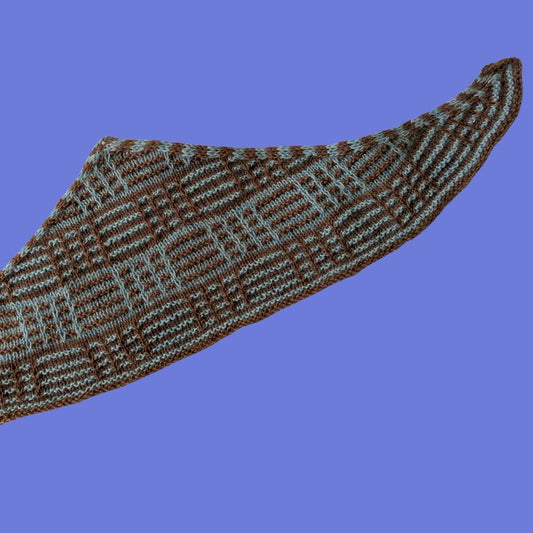
▪️ Some Knit-sis patterns (e.g. Splashie , Mondrian ) can serve as a basis for simple pieces to automate, then customize manually.
4. Knit-sis testimonials & anecdotes
When we were little, our grandmother knitted everything by hand. Knitting was a family moment, a slow meditation. Later, when we tried a machine to create swatches faster, we loved it but also stumbled: dropped stitches, snagged yarn, settings that "weren't right for that yarn."
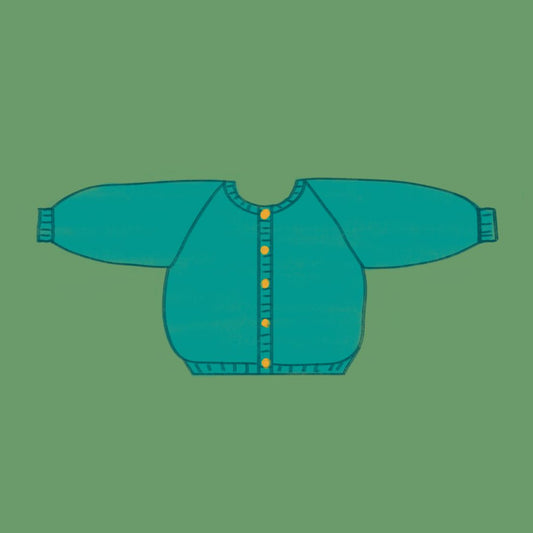
For example, during the development of the Cardichou vest , we tried to "machine-knit the back" but abandoned it for the shoulders; it was simpler and safer to hand-knit the sleeves to maintain the consistency and flexibility of the design.
These experiences confirm that the machine is a great tool , but it does not replace the intuition, creativity and sensitivity of hand knitting.
5. Tips for switching from manual to machine (and vice versa)
5.1 Adapting a hand-drawn pattern to the machine
▪️ Simplify the pattern if the machine cannot handle too many jumps
▪️ Test the sample on the machine with the yarn you want to use
▪️ Use markers and guides to “see” where the pattern goes.
▪️ Be patient with the machine's errors; they are normal.
5.2 Transforming a "machine" part for hand finishing
▪️ Gather the edges by working the stitches back up to create ribbing
▪️ Add decorative details by hand (embroidery, patches)
▪️ Pay attention to the joins to ensure a seamless finish
5.3 Avoid these common pitfalls
▪️ Do not test multiple yarns: some wools do not "glide" well in the machine
▪️ Thinking that “everything will be easier”: the curve exists
▪️ Neglecting machine maintenance, lubrication, and cleaning
6. Knit-sis Patterns
Here are some Knit-sis patterns:
▪️ Cardichou (The Cabbage Vest) : an affordable top-down vest ▶️ See the Cardichou pattern
▪️ Splashie : structured by colors, it's an excellent base for experimenting with patterns ▶️ See the Splashie pattern
▪️ Mondrian : geometric block model ▶️ See the Mondrian pattern
Conclusion
Choosing between machine knitting and hand knitting isn't a duel; it's a question of project, enjoyment, budget, and time . For us at Knit-sis, every stitch counts, whether automated or handcrafted.
Start slowly, experiment, and let yourself be guided by your thread and your creativity.
👉 Sign up for our newsletter to receive advanced technical guides (machine maintenance, pattern conversion, hybrid tips).
Happy experimenting, beautiful stitches, and long live knitting creativity! ✨
With affection,
Lenny & Louise, your knit-sis sisters


