




How to knit small patterns to personalize your accessories?
Knit SisShare
Do you dream of adding a unique, playful, and personalized touch to your hats, mittens, scarves, or cardigans? Do you want to knit small motifs—hearts, stars, letters, mini-flowers—directly into the stitches, without hesitating or having to redo the entire project? 🎯
In this article, we'll guide you step by step: when , how , which tools , mistakes to avoid , and concrete examples inspired by Knit-sis patterns (which you can personalize). It's a complete resource for beginner or experienced knitters who want to take this exciting step.
“Ever since my grandmother taught me to ‘draw with stitches,’ I can no longer knit without imagining little secret motifs in each project.” Lenny & Louise (Knit-sis)
1. Why knit small patterns? (and for which accessories)
🧶 The advantages of an integrated design rather than an applied one
▪️ Cleaner & more sustainable : the pattern is "in" the knit, not sewn on top
▪️ Fewer finishing steps : no sewing, no gluing or topstitching A delightful “surprise” effect : a small flower, an initial, or a discreet logo transforms a simple accessory into a personal piece.
▪️ A progressive learning of colour/pattern techniques
What types of projects is it suitable for?
Here are some accessory ideas where small patterns fit in very well:
▪️ Beanies or toques (discreet pattern on the front)
▪️ Mittens or gloves (around the wrist or back of the hand)
▪️ Snoods or collar (light patterned band)
▪️ Shawl borders
▪️ Pockets, inside pocket
▪️ Sleeve edges, hems
And of course, for your larger knits, you can introduce a discreet motif near the neckline, or on a sleeve, as a signature element.
2. Small-format pattern techniques: jacquard “pulled threads” vs. intarsia
(Let's explore the two main families for small patterns)
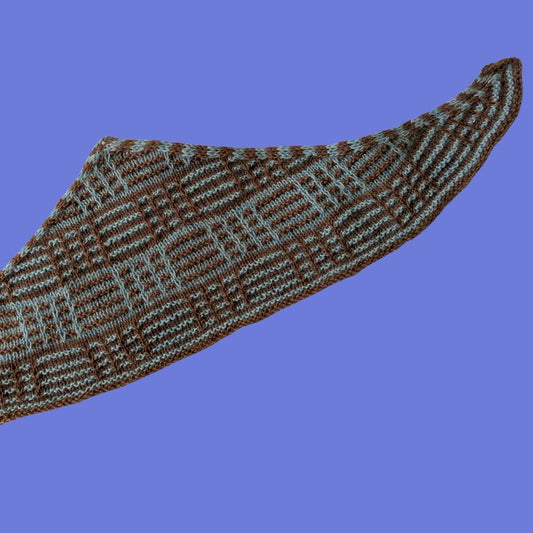
2.1 Drawn-thread jacquard (the most commonly used method for small patterns)
This is the ideal method when the pattern has only a few stitches (3–5 stitches), and the color variations are not long.
Principle :
▪️ You knit your base yarn, and when you reach a pattern stitch, you change color.
▪️ The unused yarn “floats” on the wrong side, but at regular intervals (every 3–4 stitches), you cross the yarns to prevent them from being too loose or “pulling”.
▪️ With each change, be careful not to pull too hard on the thread so as not to distort the pattern or the work.
Invisible crossover tip :
When you switch from color A to color B, pass yarn A over yarn B on the back, then knit the stitch in color B. When you return to A, pass yarn B over yarn A. This creates a discreet crossing and prevents the pulled yarn from looking "messy" on the right side.
👉 This technique is comfortable up to ~4–5 consecutive stitches of color. If your pattern extends beyond that, you'll find the back becomes too cluttered or too thick.
2.2 Intarsia (for larger patterns or blocks of color)
When your pattern has a large area (for example, a heart filled with 10 pattern stitches), intarsia becomes more suitable.
Principle :
▪️ We use mini bobbins or mini cones for each pattern color
▪️ The thread is not left hanging loose on the back; each color has its own thread
▪️ We “cross” or “link” the colors at the interface between two zones at the transition point
This approach avoids the thickness and tangling of the threads but requires rigorous management of the threads and bobbins.
Which technique should be chosen depending on the design?
|
Pattern size |
Number of colors |
Recommended technique |
|
3 to 5 stitches, 2 colors |
weak |
jacquard with drawn threads |
|
5 to 10 stitches, 2 colors |
average |
Jacquard with frequent crossing or light intarsia |
|
Large pattern (more than 10 stitches), or 3+ colors |
forte |
intarsia |
💡 In general, for your small personalized designs, you will always start with the jacquard with drawn threads, it is easier to manage when you are still in the learning phase.
3. Practical steps for knitting a small motif: a step-by-step tutorial
Here is a practical method for tackling a small motif such as a mini-flower, a heart or a letter.
Step A: Create or choose a pattern grid
1️⃣ Decide on the design : flower, star, initial…
2️⃣ Draw on a grid : one square = 1 stitch; one line = 1 row
3️⃣ Define the area : add margins of “background color” around the design to integrate it harmoniously
4️⃣ Plan for yarn transitions : identify where the colors change
Example: a 5×5 stitch heart, surrounded by 2 bottom stitches on each side, and 2 bottom rows at the top and bottom.
Step B: Make a sample
Before incorporating it into your project, make a small swatch of the pattern (for example, 20 x 20 stitches) with your yarn and needles. This allows you to test: the tension, the readability, and the back thickness.
Step C: Choosing the right location
Decide where you want to incorporate the motif in your project. For example, on a hat, you can center it at the front or slightly off-center. On a collar, you can repeat it.
Make sure that the pattern does not fall on very irregular areas (armholes, seams) at the beginning.
Step D: Knit the pattern
1️⃣ Knit to the point where your pattern begins
2️⃣ Follow your grid, stitch by stitch
3️⃣ When changing colors, cross the threads in reverse to trap the unused thread.
4️⃣ Check the back regularly: the threads should not be too tight or too loose
5️⃣ Continue until the end of the pattern, then return to the background color
Step E: Finishing touches and checks
▪️ On the reverse side, tuck the loose ends into the corresponding colored area, hiding them within it.
▪️ Apply a light blocker (spray lightly) to loosen the threads
▪️ Check that the pattern is regular and without constrictions.
4. Common mistakes & solutions (to be absolutely avoided)
|
Issue |
Probable cause |
Solution / Tip |
|
The pattern is "tight" and too compact. |
Excessive tension on the unused wire |
Loosen the yarn slightly between the stitches. |
|
Threads hanging too long and upside down |
No crossings or excessive spacing between crossings |
Cross every 3–4 stitches, even without a color change |
|
“Blurred” pattern |
fuzzy or poorly defined thread |
Use a well-defined yarn; avoid fuzzy yarns for the patterns. |
|
Too thick at the back |
Misuse of intarsia or unmanaged multiple threads |
Reduce the number of changing threads or opt for intarsia if using a large pattern |
|
Grid reading errors |
You always read the grid in the same direction. |
When knitting in the round, read from right to left; when knitting flat, alternate the direction according to odd/even rows. |
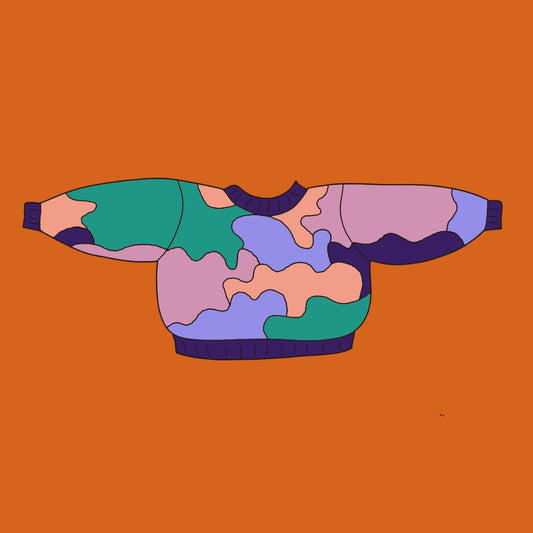
🧵 Fun fact: During our first prototype of the Splashie pattern , we incorporated a very fine "water droplet" motif near the hem. With too much tension, it bunched up. We fixed it by slightly loosening the threads and repeating the swatch three times. Since then, this motif has become a much-loved signature detail. (Yes, we experiment on ourselves too 💛)
5. Examples of Knit-sis patterns to personalize + inspiration
Here are some Knit-sis patterns that you can "customize" with small motifs:
▪️ Splashie sweater : this model already offers a beautiful structure, add a small discreet pattern on the hem or pocket.
▪️ Mondrian sweater : you can adapt the geometric grid with your colors, or insert your initial.
▪️ Elmer Vest : its color blocks lend themselves perfectly to an intermediate pattern variation.
In addition, you could take inspiration from the Fair Isle style (knitting in limited colours, repeated patterns) which limits the tangling of yarns.
Or the Selburose pattern , this beautiful Scandinavian star often reduced to a central motif.
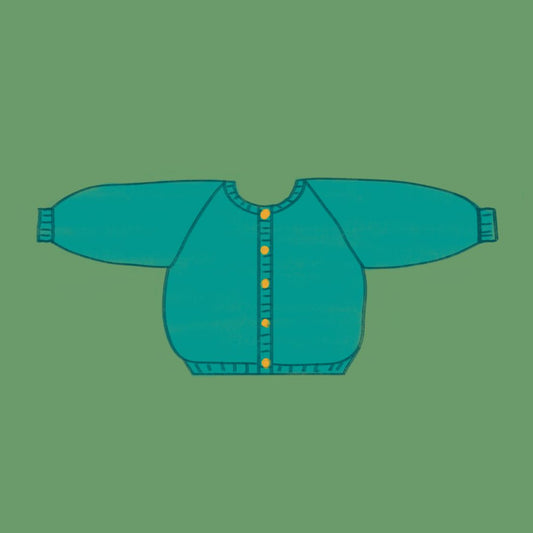
🔗 If you are looking for an easy modular pattern, also take a look at the Cardichou pattern (Le Gilet Chou) , a soft, top-down vest that makes a beautiful canvas for your personalized designs.
▶️ See the Cardichou pattern
7. Conclusion
Knitting small motifs into your projects is like diving into a playful, rewarding world full of personality. It's a bit like adding a secret message or a touch of whimsy to every stitch.
Key points to remember:
▪️ Start with the pulled yarn jacquard for patterns of 3 to 5 stitches
▪️ Always cross the threads in reverse to avoid loose threads
▪️ For a larger pattern, switch to intarsia
▪️ Make a sample, check the reverse side, and block lightly
▪️ Get inspired by existing patterns and have fun!
👉 To learn more, explore our patterns
👉 Did you like this article? Sign up for our newsletter to receive free knitting patterns, exclusive design ideas and early access to our upcoming patterns.
Lenny & Louise, Knit-sis's two sisters 💛


