






How to calculate the number of stitches for a sweater? The complete guide
Knit SisShare
To calculate the number of stitches to cast on for a sweater, the basic rule is simple: multiply the desired width (in cm) by the number of stitches obtained over 10 cm with your swatch. This small formula allows you to convert a body measurement into a precise stitch count — regardless of the yarn, needles, or desired size.
But to get a sweater that really fits well, you need to go a bit further than the raw formula: gauge, ease, distribution between the body, sleeves, and collar, adjustments according to the chosen stitch pattern... In this guide, we'll go back to basics, step by step, as if we were knitting side by side. By the end, you'll know how to calculate the number of stitches to cast on yourself, whether you're following a Knit Sis pattern or designing your own custom model.
Table of Contents:
- Information to gather before calculating
- The step-by-step formula (with a numerical example)
- Detailed calculation per part of the sweater (body, sleeves, collar)
- An indicative stitch chart by size
- Adapting the calculation to your own gauge
- Common errors that skew the result
- Frequently asked questions
1. The 3 pieces of information to gather before calculating your stitches
Your gauge, or "swatch"
Gauge corresponds to the number of stitches and rows you get over a 10 × 10 cm area with your yarn, needles, and stitch pattern. This is the pivotal data: the entire sweater calculation depends on it.
To measure it correctly:
- Cast on a swatch of at least 12 × 12 cm (slightly larger than 10 × 10, to have a reliable central area to measure, away from the edges which tend to distort).
- Knit in the main stitch pattern of the sweater (stockinette, textured stitch, etc., depending on the model).
- Block the swatch (gentle wash + flat drying): the stitches often change after blocking, sometimes significantly depending on the fiber.
- Count, in the central area, the number of stitches over 10 cm in width and the number of rows over 10 cm in height.
You thus obtain two essential ratios:
stitches per cm = number of stitches ÷ measured width (cm) rows per cm = number of rows ÷ measured height (cm)
Your bust circumference
Measure the widest part of your bust, with the tape measure horizontal, without pulling it tight. If the sweater is to be worn over a layer (shirt, thick t-shirt), measure with that layer to avoid ending up with a garment that's too snug.
Your ease
Ease is the difference between your bust circumference and the final width of the sweater. It determines the fit:
- Fitted / close-fitting: + 0 to + 4 cm
- Classic fit: + 6 to + 10 cm
- Loose / oversized: + 12 cm and more
This choice is made before the calculation, as it directly influences the number of stitches to cast on.
2. The formula for calculating the number of stitches for a sweater
Once you have the gauge and measurements, the calculation is done in three steps.
1️⃣ Determine the width to cover. Total sweater width = bust circumference + ease. For the front or back, you generally work on half of this width.
2️⃣ Multiply by your gauge.
Number of stitches = desired width (cm) × stitches per cm
3️⃣ Adjust according to edgings. If necessary, add a few stitches for ribbing, selvage edges, or a garter stitch border.
Numerical example: you want 50 cm width for the half-front, and your swatch gives 2.3 stitches per cm. 50 × 2.3 = 115 stitches to cast on for this piece (round up or down according to your pattern's multiple, see below).
This formula works for a simple, stockinette sweater without any special shaping. For a complete calculation, you need to apply it to each part of the garment — which is the subject of the next section.
3. Calculate the number of stitches for each part of the sweater
The body: back and front
Same formula as above, applied separately to the back and front (they may have slightly different widths depending on the pattern, especially if the neckline is lower on the front).
The sleeves
Sleeves are calculated at two points: the width at the shoulder (widest) and the width at the wrist (narrowest), then the two are connected by regular increases.
Shoulder stitches = shoulder width (cm) × stitches per cm Wrist stitches = wrist width (cm) × stitches per cm
Example: shoulder 34 cm and wrist 20 cm, gauge 2.2 stitches/cm.
- Shoulder: 34 × 2.2 = 74.8 → 75 stitches
- Wrist: 20 × 2.2 = 44 → 44 stitches
You cast on 44 stitches at the wrist, then gradually increase to 75 stitches at the armhole, distributing the increases over the length of the sleeve.
The collar and neckline
For a ribbed collar (which needs to stretch to fit over the head), first calculate the neck circumference × stitches per cm, then reduce this figure by 10 to 15% because ribbing naturally tightens the fabric.
Example: neck circumference of 38 cm, gauge of 2.4 stitches/cm in stockinette. 38 × 2.4 = 91 stitches in flat fabric, reduced to approximately 78-80 stitches once the "elastic ribbing" effect is taken into account.
4. Indicative chart: number of stitches by size
As a guide (gauge 20 stitches / 10 cm in stockinette, classic ease of + 6 cm) — always adjust with your own swatch, this chart never replaces a personalized calculation:
| Size | Bust circumference | Sweater width (+6cm) | Back/front stitches (each piece) |
|---|---|---|---|
| 36 | 84 cm | 90 cm | ≈ 90 stitches |
| 38 | 88 cm | 94 cm | ≈ 94 stitches |
| 40 | 92 cm | 98 cm | ≈ 98 stitches |
| 42 | 96 cm | 102 cm | ≈ 102 stitches |
| 44 | 100 cm | 106 cm | ≈ 106 stitches |
| 46 | 104 cm | 110 cm | ≈ 110 stitches |
| 48 | 108 cm | 114 cm | ≈ 114 stitches |
| 50 | 112 cm | 118 cm | ≈ 118 stitches |
If your gauge is not 20 stitches/10 cm, refer to the conversion method below rather than this chart.
5. What if your gauge is different from the one indicated in the pattern?
This is one of the most frequent cases: you change yarn, and your gauge no longer exactly matches the pattern's. No need to recalculate everything from scratch — just apply a ratio:
- Divide your gauge by the pattern's gauge → this is your conversion ratio.
- Multiply the pattern's stitch count by this ratio to get your new stitch count.
Example: the pattern indicates 20 stitches / 10 cm and asks to cast on 200 stitches. Your swatch gives 22 stitches / 10 cm. Ratio = 22 ÷ 20 = 1.1 New stitch count = 200 × 1.1 = 220 stitches
This conversion method is widely used in the English-speaking knitting community; for example, it's detailed by Tin Can Knits or Cocoknits, and the basics of gauge are well explained in Ysolda's "Gauge 101" guide.
6. Adapt the calculation according to the stitch pattern and motifs
The basic calculation assumes plain stockinette knitting. As soon as you introduce a motif, you need to refine:
- Cables: they "eat up" width by crossing stitches. A cable tightens the fabric compared to simple stockinette: you often need to add a few stitches to compensate and achieve the desired width.
- Lace / openwork stitches: conversely, these stitches tend to widen the fabric once blocked. Always knit the swatch in the actual motif, never in stockinette alone if the sweater contains a lot of lace.
- Central motif (single cable, lace panel): ensure your total stitch count allows you to center the motif without cutting it off awkwardly.
- Edgings (ribbing, garter stitch): plan for a few extra stitches for the transition between the edging and the main motif.
- Pattern multiple: if your motif repeats every 8 stitches, for example, round your total to the closest multiple of 8 (adding border stitches separately).
7. Don't forget the number of rows
The number of stitches gives the width, but it's the number of rows that gives the length. The logic is identical:
Number of rows = desired height (cm) × rows per cm
Example: for a bust length of 40 cm with a gauge of 2.8 rows/cm, you need to knit 40 × 2.8 = 112 rows before the armhole.
8. The most frequent errors (and how to avoid them)
- Not making a swatch, or using an unblocked swatch → the actual gauge changes after washing and skews the entire calculation.
- Measuring the swatch "stretched" between your fingers instead of laying it flat naturally.
- Rounding your stitch count without considering the pattern multiple → motif cut off or misaligned.
- Forgetting border or ribbing stitches → the final sweater is narrower than expected.
- Ignoring the impact of motifs (cables, lace) on local gauge.
- Keeping the stitch count indicated by a pattern without recalculating, even though you've changed yarn.
- Calculating each part separately without checking overall consistency (e.g., armholes of the body incompatible with the top of the sleeve).
9. Complete example: from bust circumference to finished sweater
Let's recap with a concrete case:
- Bust circumference = 96 cm
- Desired ease = + 6 cm → total width 102 cm → half-front 51 cm
- Gauge = 2.4 stitches / cm
- Body: 51 × 2.4 = 122.4 → cast on 122 or 124 stitches depending on the pattern multiple
- Sleeves: shoulder 32 cm and wrist 19 cm → 32 × 2.4 = 77 stitches at the shoulder, 19 × 2.4 = 46 stitches at the wrist
- Ribbed collar: neck circumference 36 cm → 36 × 2.4 = 86 stitches flat, reduced to approximately 73-75 stitches once the elasticity of the ribbing is taken into account
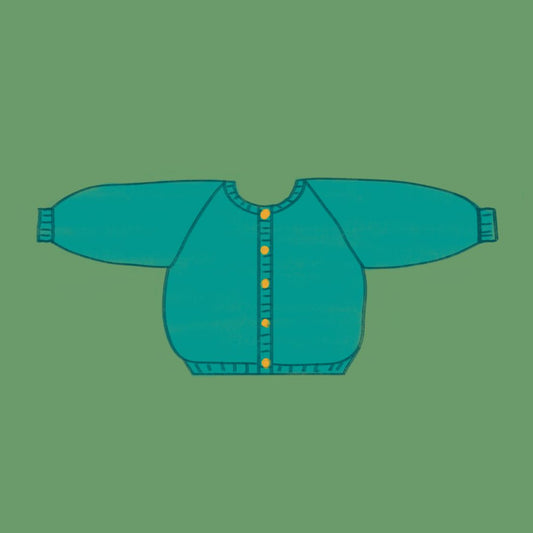
You can apply exactly this logic to adapt an existing pattern to your body shape. For example, you can do this with the silhouette of the Chou Cardigan (Cardichou): you keep the structure (raglan placement, proportional decreases) but recalculate the base stitches with your own gauge and measurements, to transform the cardigan into a perfectly fitted long-sleeved sweater.
Frequently asked questions
How many stitches should I cast on for a size 38, 40, or 42 sweater? This depends entirely on your gauge. As a guide, with a classic gauge of 20 stitches/10 cm, you cast on about 94 stitches per piece (back or front) for a size 38, 98 for a size 40, and 102 for a size 42 (see the chart above). But these are guidelines: your own swatch always takes precedence.
How do I calculate the number of stitches for sweater sleeves? Measure the desired width at the shoulder and wrist, then multiply each by your gauge (stitches per cm). You get the number of stitches at the armhole and wrist, to be connected by regular increases along the sleeve.
What if my stitch count is not a multiple of my pattern? Round to the nearest multiple (up or down depending on the ease you can afford to gain or lose), and compensate for the width difference in the border stitches rather than in the pattern itself.
How do I calculate the number of stitches without a pattern, just from my measurements? Make a swatch in the chosen stitch pattern, measure your gauge, determine your target width (bust circumference ÷ 2 + ease), then apply the formula: width × stitches per cm. This is exactly the method detailed in this guide.
How many rows do I need to knit for a sweater? The number of rows is calculated like the number of stitches, but for height: desired length (cm) × rows per cm of your swatch.
What if I don't get the same stitch count as indicated in the pattern with my yarn? This is normal if your gauge differs from what the designer intended. Use the ratio conversion method (section 5) instead of forcing a needle size to "match" the pattern: it's better to change needle size until you get the gauge that suits you, or recalculate with your own gauge.
Conclusion
Calculating the number of stitches for a custom sweater is a bit of math, a bit of method, and a lot of freedom. Once you understand the logic — swatch, width, multiplication, adjustments — you can adapt any pattern to your body shape, or create your own from scratch, without depending on standard sizes.
👉 Discover the entire Knit Sis pattern collection to put this method into practice, or consult our basic knitting techniques if you're a beginner.


