






⭐ Creating invisible closures and integrating a zipper into knitting: the Knit-sis method
Knit SisShare
When we learned to knit with our grandmother and aunt, there was a sacred phrase:
“A nice finish, it’s a project we’re really passionate about.”
And they were right. Nothing elevates a cardigan or sweater like a perfectly integrated closure , whether it's an invisible zip or a clean, even button band.
Here is our complete, step-by-step method for achieving clean, professional, and totally invisible closures… even if you have never installed a zip in your life.
Why choose an invisible closure or an integrated zip?
An invisible zipper can transform a knit garment:
▪️ It gives an ultra-clean , couture effect .
▪️ It reinforces the structure without adding volume.
▪️ It allows you to obtain a vest that hangs perfectly straight.
▪️ It is suitable for children (no buttons to manipulate).
▪️ It modernizes a simple cut vest.
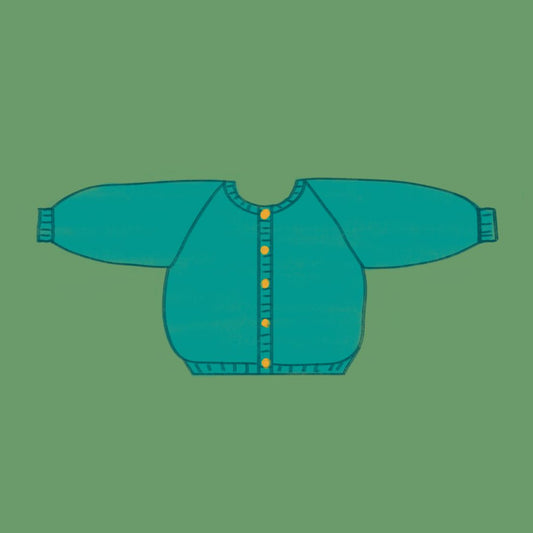
We use this technique, for example, on prototype variations of the Cardichou vest , when we want a more structured look or a very clean finish for children's sizes.
Mistakes that make closures visible (and how to avoid them)
Many knitters experience the same minor frustrations:
▪️ A wavy band
▪️ A zipper that pulls or creates a crease
▪️ An opening that widens
▪️ A zipper that's too stiff for the knit
▪️ A seam that is visible on the right side
The good news: all of this can be avoided with three simple rules that our grandmother used to repeat constantly.
The three golden rules for an invisible closure
Choosing the right bandwidth
A band that is too narrow pulls.
A band that is too wide is floating.
The correct width = 2 to 2.5 cm depending on the thickness of the wire.
Stabilize without stiffening
You don't knit a zipper "in the air".
The zipper is always placed on a stable surface , such as:
▪️ a band knitted in garter stitch,
▪️ a band preceded by a row of reinforcement (slipped stitches),
▪️ or, for advanced knitters, an i-cord border.
Sew gently and evenly
Invisibility = tiny dots + regularity.
You never pull on the thread: you follow the stitch .
Prepare your knitting before installing the zipper
For a successful invisible closure, preparation does 70% of the work.
Block or lightly press your strips
This prevents rippling and puts the mesh in place.
Mark the landmarks
Place a marker at:
▪️ each end
▪️ every quarter
▪️ and ideally every 2 to 3 cm
This ensures that the zip will be properly aligned and that nothing will pull.
Choose the right zip
The best choices:
▪️ Spiral nylon zip (flexible, perfect for knitwear)
▪️ Non-separating zipper for children
▪️ Separable zip for adult vests
Knit-sis tip: if the knit fabric is stretchy, choose a zipper 1 to 2 cm shorter than the opening. It will fit like a dream.
Embedding an invisible zip file: the step-by-step method
1. Open the knitted strip
Your strip should be flat and even.
If it rolls, knit 2 to 4 rows in garter stitch .
2. Lay the knitting flat
The side facing you, zip behind the band.
3. Pin without pulling
Use thin stainless steel pins or fabric clips.
Avoid using large pins that distort the knit.
4. Sew with small, invisible stitches
Sew between the stitches, not through .
We stitch the inner stitch, never the visible stitch.
5. Check the alignment every 3 cm
Unzip, re-zip: if it bunches up in one spot, we adjust it.
6. Secure the second half
Same method, same benchmarks.
The secret to success: equal tension on both sides.
How to get a perfectly straight zipper
A straight closure relies on two elements:
Light stabilization
You can reinforce the band with:
▪️ a row of slipped stitches
▪️ a thin thread passed through the edge
▪️ or a very fine twill ribbon
Parallel placement
The zip should always be positioned 1 mm back from the edge of the knit.
This tiny shift creates… total invisibility.
Alternatives: invisible button bands
If you prefer buttons:
▪️ Knit a band in garter stitch
▪️ Pick up your stitches regularly
▪️ Use the invisible button technique (the strap sewn on the inside)
This finish works very well on simple designs, or in a retro style, like our Tulip jacquard vest .
Advanced finishing techniques: machine application vs. hand stitching
Hand sewing (recommended)
✓ better control
✓ truly invisible points
✓ No deformation
Machine sewing (possible with caution)
✓ very fast
✗ risk of stretching the mesh
✗ requires a suitable machine
If you try the machine:
▪️ Use a thin zigzag stitch
▪️ Place a piece of water-soluble paper on top to stabilize it
▪️ Sew at a slow speed only
The best threads and stitches for installing a zipper
The wires that work best
▪️ merino
▪️ alpaca-merino
▪️ cotton
▪️ “Ply” wools (which retain their shape)
Avoid very fluffy wools or blown yarns, which sometimes hide the seam too much (difficult to fix if there is a mistake).
The most suitable points
▪️ Jersey stitch : the most common
▪️ Foam stitch : excellent for stability
▪️ 1/1 ribs : be careful of elasticity, stabilize before
How to make the closure truly invisible
Here is our personal technique, passed down through the family:
“Sew 1 mm from the zip and 1 mm from the edge. You become invisible by symmetry.”
It's simple, and it works every time.
1. The zip is positioned slightly recessed
It should not be flush with the edge of the knitting.
2. The dots are evenly spaced
Approximately every 2 mm.
3. We choose a tone-on-tone thread
Or a yarn half a shade darker (it disappears better in the knit).
Frequently Asked Questions (FAQ Knit-sis)
Does a zip make a child's vest heavier?
No, if you choose a nylon spiral zip.
Can you put a zip on mohair?
Yes, but reinforce the band with a thin wire.
Will the knit fabric stretch around the zip?
No, if the band is stabilized and the stitching is regular.
Want to train?
Here are three perfect projects to practice:
▪️ Cardichou — a modern top-down vest, ideal for understanding how to lay it on jersey.
▪️ Tulip — Retro jacquard pattern, perfect for stabilizing edges.
▪️ Your next simple jersey vest: it's often the best testing ground!
Conclusion: a finish that changes everything
Inserting an invisible zipper might seem daunting… but once you know the right techniques, it's one of the most rewarding finishing touches in knitting. And above all, it's this little detail that transforms a handmade cardigan into a piece you'll wear again and again —just like our grandmothers used to say.
If you try this technique, we would love to see your results.
And if you're looking for a perfect model to test: the Cardichou is your best ally!
You can also discover all our other models for even more inspiration.


