




🧶 Knitting top-down with yoke or raglan: understanding the construction in depth
Knit SisShare
You've spotted a top-down pattern with a lovely rounded yoke or beautiful raglan lines, but you're still hesitating between the two constructions? You've come to the right place!
In this comprehensive guide, we'll explain the differences between a yoke and a raglan, their advantages, their specific characteristics, and most importantly, how to choose the ideal construction based on your body shape, skill level, and preferences.
Whether you want to knit a top-down sweater, a seamless cardigan, or simply understand the instructions of a modern pattern, you'll find all the answers here.
Why we love top-down knitting (and why you will too)
At Knit-sis, we grew up surrounded by yarn, lattes, and long discussions between our grandmother and aunt about the most beautiful finishes. So when we discovered top-down knitting, it was a real revelation.
The principle is simple: you start the garment at the neckline, then knit downwards until you have a fully finished sweater or cardigan, usually seamless.
Today, this method has become essential in modern knitting.
Advantages of top-down
✔ No assembly required
✔ Try-ons possible throughout the project
✔ Easily adjustable sleeve and body length
✔ Simpler management of stripes and color changes
✔ Ability to use all available yarn without waste
✔ Very motivating progress: you quickly see your garment taking shape
To remember: top-down is an ideal construction for both beginners and experienced knitters.
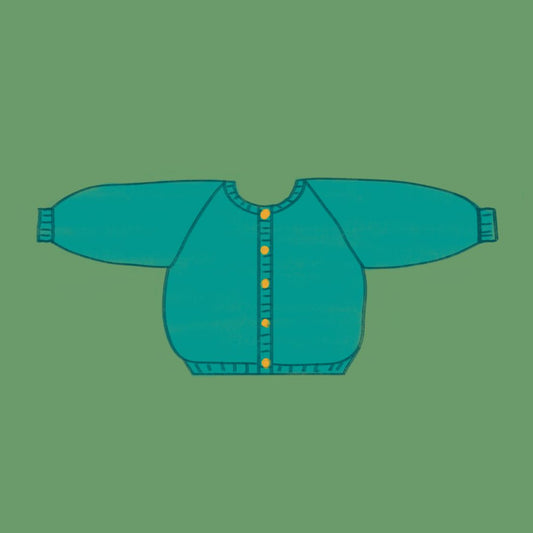
👉 If you want to discover this method, our Cardichou is an excellent first project: a fluffy raglan cardigan knitted with 7 mm needles.
What is a top-down sweater?
A top-down sweater is a sweater knitted from the top down, starting with the collar before forming the shoulders, sleeves, and then the body.
Unlike traditional constructions made in several pieces, a top-down sweater is generally knitted in one piece.
This method offers numerous advantages:
- trying on the garment while knitting;
- easily adjusting sleeve or body length;
- achieving impeccable finishes;
- avoiding long sewing sessions at the end.
It is now the preferred construction for many modern pattern designers.
Can you knit a top-down sweater with circular needles?
Yes, and it's even the most commonly used method.
Circular needles allow you to distribute the weight of the project over the cable, making knitting much more comfortable, especially for sweaters and cardigans.
They also make it easy to knit in the round, which is essential for most top-down patterns.
Even if their name can be misleading, circular needles are also used for flat knitting.
Why use them?
- less wrist fatigue;
- no assembly;
- easier try-ons;
- ideal for large projects;
- better distribution of the garment's weight.
All our top-down patterns are designed to be knitted with circular needles.
Yoke vs. Raglan: two constructions, two styles
The yoke (circular yoke)
The yoke, also called a circular yoke, is recognizable by its soft curve around the shoulders.
Increases are distributed regularly over the entire circumference of the yoke, which gives a very fluid silhouette.
This construction is particularly popular on Icelandic sweaters, jacquards, and Scandinavian designs.
We love the yoke for:
✔ its soft drape
✔ its comfort
✔ its elegant look
✔ its enhancement of jacquard patterns
The yoke is particularly suitable for people with rather narrow or sloping shoulders.
Our Strippie sweater is an excellent example of this construction.
The raglan
The raglan is immediately recognizable thanks to its four diagonal increase lines connecting the collar to the armpits.
These lines bring more structure to the garment and allow for very easy adjustment of shoulder width or armhole depth.
We love the raglan for:
✔ its modern silhouette
✔ its great ease of adjustment
✔ its comfort
✔ its adaptability to all body types
At Knit-sis, Cardichou is undoubtedly our best raglan ambassador.
Designed for beginners and experienced knitters alike, it allows you to discover top-down knitting with ease.
Our Festi cardigan is also constructed with raglan sleeves.
To remember: the raglan offers a more structured silhouette while the yoke provides more softness.
What does "yoke" mean in knitting?
The English word yoke simply means yoke.
In knitting, it refers to the entire upper part of a garment connecting the collar, sleeves, and body.
There are two main families:
- the circular yoke, where increases are distributed all around the collar;
- the raglan yoke, built around four lines of increases.
The term yoke is now used in the majority of international patterns, even when translated into French.
You will often find it on Ravelry, Pinterest, or Instagram.
How to choose between a yoke and a raglan?
Do you like clean, structured lines?
👉 Choose a raglan.
Do you like circular patterns and jacquards?
👉 Opt for a yoke.
Do you have a generous bust or pronounced shoulders?
👉 Raglan is often easier to adapt.
Are you looking for your first top-down project?
👉 We recommend Cardichou.
Comparison table: yoke or raglan?
| Criterion | Yoke | Raglan |
|---|---|---|
| Appearance | Rounded | Structured |
| Increases | Distributed over the entire yoke | 4 diagonal lines |
| Try-on | Slightly less precise | Very easy |
| Ideal for | Jacquard, colorwork | Beginners, all body types |
| Level | Beginner to intermediate | Beginner |
💡 Save this table on Pinterest or print it out to have it handy before starting a new project.
How do you say "yoke" in other languages?
If you knit foreign patterns, you will probably encounter different terms depending on the country. Here are the main translations of the word yoke in knitting vocabulary.
| Language | Translation |
|---|---|
| 🇫🇷 French | Empiècement |
| 🇬🇧 English | Yoke |
| 🇸🇪 Swedish | Ok |
| 🇩🇰 Danish | Bærestykke |
| 🇳🇱 Dutch | Pas |
| 🇪🇸 Spanish | Canesú |
| 🇳🇴 Norwegian | Bærestykke |
Regardless of the term used, it always refers to the upper part of the garment connecting the collar, sleeves, and body.
Knowing these translations is particularly useful if you like knitting Scandinavian, Dutch, or Spanish patterns.
Frequently Asked Questions
What is the difference between a yoke and a raglan?
The yoke distributes increases over the entire yoke to create a rounded shape. The raglan uses four diagonal increase lines that structure the shoulders more.
Can a beginner knit a top-down sweater?
Yes. It's even an excellent first construction due to the absence of seams and the ability to try on the garment regularly.
Are circular needles absolutely necessary?
For the vast majority of modern top-down sweaters, yes. They make knitting more comfortable and allow you to work easily in the round.
What is the best type of top-down to start with?
Raglan is generally the easiest to understand and adapt. That's why we often recommend it for a first sweater or cardigan.
In summary
Top-down knitting is now one of the most popular constructions thanks to its simplicity and comfort.
The yoke appeals with its softness, elegance, and ability to showcase jacquards.
The raglan offers a more structured silhouette, easily adapts to all body types, and is often the best choice for beginners.
At Knit-sis, we design modern, accessible, and tested patterns so that each project is as enjoyable to knit as it is to wear.
Discover our top-down patterns
🧶 Cardichou: the ultra-soft raglan cardigan perfect for discovering top-down knitting.
🌈 Festi: a colorful and modern cardigan constructed with raglan sleeves.
✨ Strippie: a Scandinavian-inspired sweater featuring a beautiful yoke.
🎁 Are you a beginner? Also download our free pattern Pull Doudou, ideal for learning the basics of knitting.


