






Raglan Knitting: How to Knit Raglan Sleeves Easily? Complete Beginner's Guide
Knit SisShare
Introduction: Understanding Raglan Knitting
You've probably noticed those sweaters or cardigans with a pretty diagonal line running from the neckline to the armholes. ✨
This particular construction is called raglan knitting.
Highly popular in modern designs, raglan allows for the creation of comfortable garments with a lovely drape on the shoulders and a construction that is often simpler than designs with classic set-in sleeves.
At Knit-sis, we love this technique because it represents everything we appreciate in knitting: intelligent construction, an elegant result, and a garment that truly accommodates movement.
In this guide, we will explain:
- what a raglan sleeve is;
- how a raglan increase works;
- how to knit a circular raglan;
- how to create raglan sleeves step-by-step;
- which patterns to try to get started.
And at the end, you'll find a raglan cheat sheet to keep by your needles 🧶.
What is Raglan in Knitting?
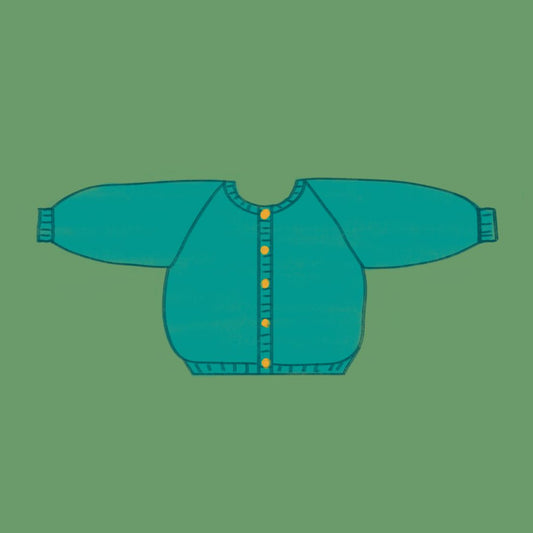
Raglan is a method of constructing a sweater or cardigan where the sleeves are integrated into the body using an increase line that starts from the collar and extends to the armhole.
Unlike classic sleeves sewn separately, raglan sleeves are generally knitted directly with the body.
Advantages of raglan:
✅ no assembly seams
✅ a natural fit on the shoulders
✅ great comfort
✅ ability to try on the garment while knitting
✅ an ideal construction for knitting in the round
This is why many current patterns use circular raglan knitting, especially sweaters and cardigans knitted using the top-down method.
How Does the Raglan Increase Work?
The key element of a successful raglan is the raglan increase.
It consists of regularly adding stitches around four raglan lines:
- front;
- left sleeve;
- back;
- right sleeve.
With each increase row or round, stitches are added on each side of the markers.
Result: the garment gradually widens to form the shoulders and sleeves.
A classic raglan increase often adds:
➡️ 8 stitches per increase round
(2 increases for each raglan line)
Different Raglan Knitting Increase Techniques
Depending on the pattern, several methods can be used.
1. Yarn Over
The simplest technique for beginners.
Knit up to the marker:
- yarn over;
- pass the marker;
- yarn over again.
Advantage:
✨ easy to spot and a pretty lacy effect.
2. Left Leaning and Right Leaning Increases (M1L and M1R)
M1L and M1R increases (Make 1 Left / Make 1 Right) create a more discreet result.
They produce a neater and more professional raglan line.
They are widely used in modern patterns.
How to Knit a Circular Raglan: Step by Step
Circular raglan knitting is generally worked from the top down.
Step 1: Cast On Neckline Stitches
Start with the collar.
The stitches are then divided into four sections:
- front;
- right sleeve;
- back;
- left sleeve.
Then place your markers to identify the raglan lines.
💡 Knit-sis Tip: Use different colored markers to easily distinguish the sleeves and back. This prevents many errors.
Step 2: Work Raglan Increases
On each increase round:
- knit to the first marker;
- make your increase;
- pass the marker;
- make the second increase;
- continue.
Repeat this step regularly according to your pattern.
Little by little, the sleeves and body magically appear ✨.
Step 3: Continue Knitting in the Round
The body and sleeves grow together.
You can knit:
-
stockinette stitch;
-
ribbing;
-
a Fair Isle pattern;
-
a textured stitch.
This is what makes raglan so interesting: the construction remains simple but allows for a lot of creativity.
Step 4: Separate Sleeves from Body
When the raglan height is sufficient:
-
place sleeve stitches on hold;
-
add a few stitches under the armhole according to the pattern;
-
continue with the body only.
This is the stage where your sweater or cardigan really starts to take shape.
💡 Tip: Take the opportunity to try it on. The top-down method allows for easy adjustment of length and ease.
Step 5: Knit Raglan Sleeves
Pick up the stitches that were left on hold.
The sleeves are then usually knitted in the round with:
-
progressive decreases;
-
a ribbed finish;
-
a stretchy bind-off.
And there you have it: your first raglan sleeves are complete 🎉.
Free Raglan Knitting Pattern: Where to Start?
If you're looking for a free raglan knitting pattern, it's best to choose a simple project with clear construction.
At Knit-sis, here are some perfect patterns to practice with:
🥕 Cardichou: The Easy Raglan Cardigan
A comfortable pattern with accessible raglan construction, perfect for discovering this technique.
🌈 Festi: A Modern Cardigan with Raglan Sleeves
A great way to learn while creating an original piece.
🍃 Doudou: Free Beginner Knitting Pattern
A cozy sweater perfect for getting familiar with top-down construction.
👉 Also discover our collection of modern cardigan patterns to find your next project.
Common Mistakes with Raglan Knitting
❌ Forgetting a Marker
This is a classic mistake.
Consequence:
- offset raglan line;
- asymmetrical sleeves.
Solution:
regularly count your stitches after each increase.
❌ Making Too Many or Too Few Raglan Increases
An incorrect increase rate can completely alter the fit.
A too-short raglan:
➡️ tight shoulders.
A too-long raglan:
➡️ armhole too low.
❌ Neglecting to Try On
The advantage of top-down raglan is precisely the ability to try it on as you go.
Take advantage of it to adjust:
- body length;
- sleeve width;
- raglan depth.
Raglan Knitting FAQ
Is raglan suitable for beginners?
Yes. Raglan is often considered an excellent construction for beginners because it avoids seams and allows you to try on the garment as you go.
What is the difference between a raglan sleeve and a classic sleeve?
A raglan sleeve starts directly from the neckline with a diagonal line, while a classic sleeve is knitted separately and then sewn to the body.
Can you knit a raglan with circular needles?
Yes. Circular raglan knitting is even one of the most popular methods, especially for top-down patterns.
How many stitches do you increase with a raglan?
Most constructions add 8 stitches on each increase round: two around each of the four raglan lines.
Conclusion: Ready to Knit Your First Raglan?
Raglan knitting is a technique that is both practical and elegant.
With its regular increases, in-the-round construction, and incomparable comfort, it allows you to create modern, seamless sweaters and cardigans, even if you are a beginner.
At Knit-sis, we love raglan because it perfectly represents our vision of knitting: accessible, beautiful designs meant to be worn for a long time 💕
So, what will be your first raglan pattern?


